
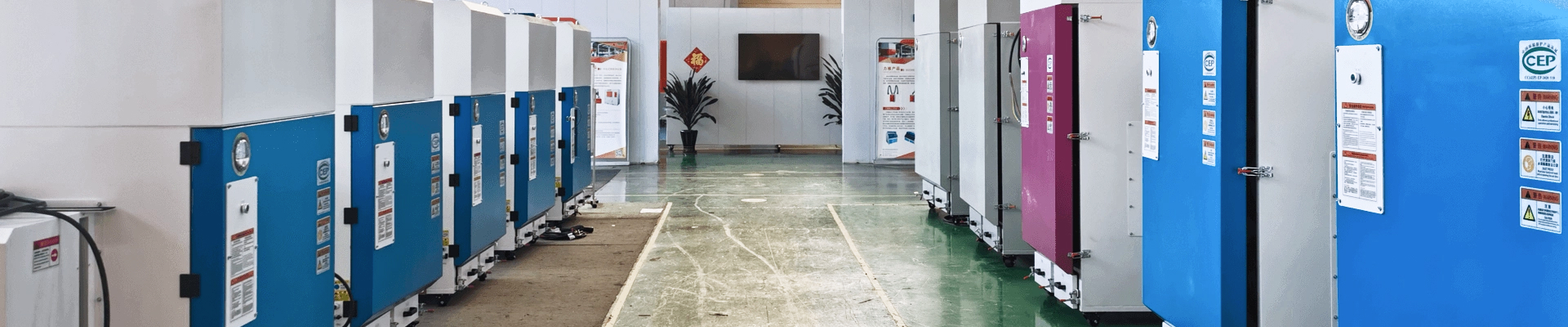
Industrial air filtration tower systems are standalone, ductless air purification units designed to capture thermal welding plumes via 360° top intake grills and recirculate filtered air at floor level. Engineered by DRIC, this fume extraction tower handles airflow rates up to 16,000m³/h with motor power ratings of 15kW. By operating without external ductwork, DRIC towers cover 200-400㎡ per unit while integrating intelligent controls to reduce electricity consumption in complex workshop environments.
System Comparison: DRIC Fume Extraction Tower vs. Traditional Centralized Ducted Extraction
Evaluating a fume extraction tower against fixed ducted systems clarifies installation, operational flexibility, and footprint trade-offs for plant layout planning:
| Metric / Technical Parameter | DRIC Industrial Air Filtration Tower System | Traditional Centralized Ducted System |
| Ductwork Installation | Zero ductwork required; standalone indoor placement. | Requires overhead main pipelines, branches, and hoods. |
| Coverage Area (Per Unit) | 200-400㎡ per single tower. | Scaled via central fan capacity and duct branches. |
| Airflow Capacity Options | 12,000-16,000m³/h (LW-C-1608S / LW-C-1609X). | Variable based on central dust collector sizing. |
| Total Filtration Surface Area | 128㎡-243㎡ filter area. | Distributed across central cartridge/bag filters. |
| Facility Mobility & Reconfiguration | High mobility; relocated via floor transport without pipe dismantling. | Fixed location; requires full ducting redesign to relocate. |
| Overhead Crane Clearance | Zero crane interference; operates below standard crane tracks. | Ducted drops and hoods often obstruct overhead cranes. |
| Noise & Power Rating | ≤ 80 dB operational noise at 15kW motor power. | Varies (18.5-45+ kW depending on total static pressure loss). |
Core Applications
Large structural-steel welding: Ambient filtration for bridge sections, long beams, heavy plates, and workpieces exceeding 20 m.
Mixed manual and robotic welding: Background fume control where fixed and movable welding stations operate in the same workshop.
Crane-served production areas: Ductless filtration for facilities using overhead bridge cranes or handling equipment that requires an unobstructed ceiling.

Product Advantages
No pipework for complex conditions: The self-contained structure eliminates overhead duct networks and supports workshops with dispersed emission points.
Intelligent electricity-saving control: Differential-pressure monitoring activates filter cleaning according to actual dust loading. Indoor-air recirculation can also reduce conditioned-air losses.
Defined area coverage: One unit is designed for approximately 200–400 m², although final quantity depends on ceiling height, welding intensity, airflow, workshop partitions, and the required air-change rate.
FAQ: Industrial Selection & Setup Guide
Q: Which fume extraction tower system is best for workshops with limited floor space?
A: Compact standalone ductless towers or outdoor-mounted central units are ideal for space-constrained workshops. Standalone units like the DRIC LW-C-1608S occupy a minimal footprint (1400 × 1260 mm) while delivering up to 12,000m³/h air purification without requiring indoor ductwork channels.
Q: How do I choose between a central ducted system and a standalone fume extraction tower for multi-station welding?
A: Fixed welding stations are well-suited for centralized ducted extraction, whereas distributed stations or shops with overhead cranes require standalone recirculating towers. Recirculating towers capture rising fumes without obstructing crane movement or requiring permanent pipeline installations.
Q: What is the recommended air filtration strategy for large-scale bridge and structural steel welding?
A: Large-scale structural welding operations require an ambient background recirculating system using high-capacity air filtration towers. Deploying multiple standalone towers (16,000m³/h capacity with 243㎡ filter area per unit) creates a continuous air exchange loop across large span halls.
Q: Will the supply air velocity from a recirculating air purification tower affect welding quality or disrupt shielding gas?
A: No, properly engineered recirculating towers do not disrupt gas metal arc welding (GMAW/GTAW) shielding gases. The low-velocity side supply air louvers release filtered air at precisely calculated air speeds, preserving shielding gas stability at the weld joint while maintaining active ambient air turnover.
Request Quote
Tell us your inquiry, we will recommend a suitable product model or solution for you!

