
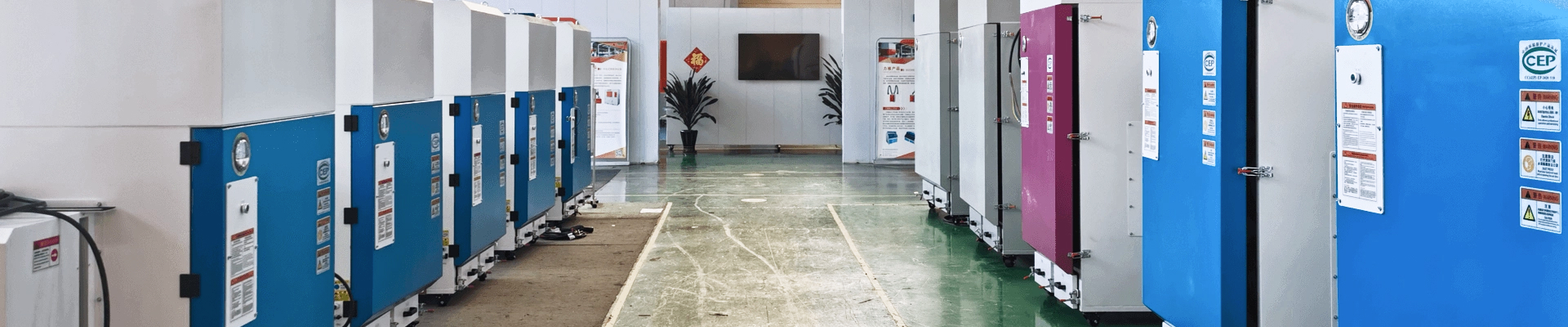
What is a mobile welding fume extractor and why is it essential for modern workshops?
A mobile welding fume extractor (also widely known as a welding smoke eater) is a highly agile, self-contained air filtration system designed to capture and filter toxic metallic particulates, gases, and smoke directly at the welding source.
Unlike traditional, high-maintenance stationary ducted systems that require weeks of installation and disrupt workshop layouts, a portable dust collector for welding offers plug-and-play flexibility. By utilizing advanced features like high-power suction fans, flame-retardant cartridge filters, and automatic pulse-jet self-cleaning systems, brands like Dric provide clean, regulatory-compliant air for highly dynamic production floors, compact shops, and robotic lines alike.
1. Industry Overview: The Shift From Fixed Ducting to Mobile Extraction
In modern metal fabrication and heavy industrial manufacturing, indoor air quality is no longer just a regulatory compliance check—it is a cornerstone of operational productivity and worker health.
Traditionally, factories relied on massive, centralized lev systems.
[Fixed Ducting Central Systems] ➔ High Downtime, Fixed Layouts, Extreme Ducting Costs
       VS.
[Dric Mobile Fume Extractors]   ➔ <1 Hour Setup, Zero Ductwork, 360° Agile Positioning
Why Industrial Fabricators are Choosing Mobile Filtration:
Total Agility & Adaptability: Portable units can be repositioned across massive manufacturing zones (e.g.,31.5m * 20m workshops) at a moment's notice.
This accommodates shifts in production lines and keeps the suction hood right where the welding arc strikes. Bypassing Installation Bottlenecks: Installing centralized ductwork can take 2 to 4 weeks and force a total facility shutdown.
A mobile fume extractor goes from unboxing to active duty in under 1 hour —simply plug it into a standard electrical outlet. High-Volume Particle Capturing: Modern mobile extractors, such as Dric's flagship 4kW units, feature massive process capacities ranging up to 3000–3500m3/h. This creates a steady, high-vacuum drafts capable of capturing dense smoke plumes before they escape into the breathing zone.
2. Deep Dive: Dric 4kW Mobile Self-Cleaning Filter Extraction Systems
For heavy-duty welding processes—including SMAW, GTAW, GMAW, pipeline, and ship-hull welding—standard light-duty extractors quickly clog up.
This professional-grade system integrates three crucial technologies to maximize performance while minimizing maintenance costs:
1. Smart Pulse-Jet Self-Cleaning Technology
Manual filter cleaning is messy and causes significant downtime. Dric's integrated pulse-jet system uses compressed air to deliver sudden, reverse-blast pulses down the center of the cartridge filter. This instantly knocks cake-on dust down into the integrated ash drawer below, restoring maximum airflow and suction without manual intervention.
2. Flame-Retardant Nano-Cartridge Filters
Welding generates hot sparks that can pose fire risks to standard paper-based filter media. Dric implements Ahlstrom nano-flame-retardant cartridge filters
3. 3D-Positional External Skeleton Extraction Arms
To capture fumes efficiently, the hood must sit close to the weld point. Dric’s extractors feature heavy-duty, 3-to-4 meter external skeleton suction arms
3. Application Spectrum: Manual to Robotic Integration
A primary reason for the popularity of the mobile welding fume extractor is its versatile application range:
| Welding Application Style | Typical Particulate Challenge | Dric Recommended Configuration |
| Manual Arc Welding (MIG/TIG/Stick) | Large-volume smoke, heavy spark discharge, moving welding positions. | 2kW or 3kW Mobile Extractor with a 360° flexible suction arm. |
| Heavy-Duty/Large-Scale Production (Pipeline, Ships) | Thick, continuous smoke plumes, toxic gases, and galvanized metal vapors. | Dric 4kW Mobile Self-Cleaning Unit with dual-arm extraction. |
| Automated Robotic Welding (Cobots & Stationary Jigs) | Fixed, highly repetitive smoke cycles; restricted spatial clearances. | On-Torch/On-Gun High Vacuum Extractor integrated directly onto the robot arm. |
4. FAQ
Q: What is the main difference between a classical mobile fume extractor and a high-vacuum on-torch extractor?
A: A standard mobile welding fume extractor uses a flexible external arm to capture smoke from a distance of about 10–30 cm above the weld pool.
Q: Why does the Dric 4kW welding fume extractor utilize an external skeleton arm instead of an internal joint design?
A: Internal joints restrict airflow, collect sticky soot deposits, and wear out quickly under constant adjustment. Dric's external skeleton extraction arm places the metal joints on the outside of the flexible hose.
Q: How do flame-retardant cartridges protect the portable dust collector from catching fire?
A: Dric's Ahlstrom nano-flame-retardant cartridge filters are treated with specialized chemical compounds that prevent combustion.
Request Quote
Tell us your inquiry, we will recommend a suitable product model or solution for you!

