
How do DRIC laser dust collection systems perform under demanding real-world manufacturing conditions?
In high-power metal fabrication, deploying a dedicated laser dust collection system transforms factory air quality, protects expensive optics, and guarantees environmental compliance. Designed by DRIC, our heavy-duty laser dust extractors and laser cutter dust collectors integrate high-vacuum suction fans (4000-16000m³/h), multi-stage mechanical spark arrestors, and flame-retardant PTFE nanofiber cartridges with automated pulse-jet cleaning. Across diverse industrial deployments—from high-speed fiber laser sheet cutting to large-format gantry tables—DRIC solutions maintain stable negative pressure and achieve 99.9% filtration efficiency down to 0.3μm, maximizing operational uptime.
1. Real Case Comparison: DRIC Laser Dust Extraction Deployments
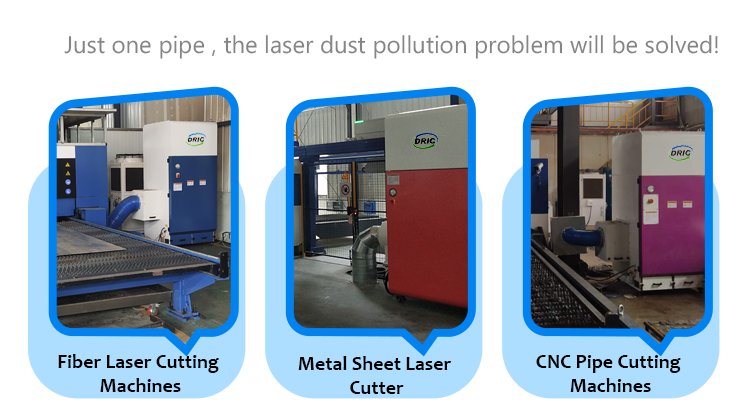
The following matrix compares three distinct industrial application scenarios where DRIC engineered custom extraction networks to meet specific production challenges:
| Application | Machine Setup & Cutting Power | DRIC System Model | Primary Technical Challenge | Measured Performance Outcome |
| Case 1: Enclosed Sheet Fiber Laser | 3015/4020 Exchange (6kW Fiber Laser) | DRIC LW-S-1204-055 (5.5kW) | Rapid soot accumulation on protective lenses; ambient smoke leakage during bed exchange. | Zero lens haze; 99.97% fume capture at zoned bed dampers; clean workshop air return. |
| Case 2: Medium-Format Heavy Plate Cutting | 4020 / 6020 Zoned Table (12kW Fiber Laser) | DRIC LW-S-1206-075 (7.5kW) | Heavy carbon steel spark showers and sticky sub-micron dust cake clogging standard filters. | Spark arrestor dropped 100% glowing embers; automated pulse-jet extended filter life to 24+ months. |
| Case 3: Large-Format Open Gantry Table | 6020+ Large Format Bed (20kW}+Fiber / Plasma) | DRIC LW-S-1209-110 (11kW}) | Massive air volume requirement across open cutting bed with strong cross-drafts. | High-pressure airflow (8000-9000m³/h) contained fumes; fully compliant with local exhaust standards. |
2. Step-by-Step Case Implementation Protocol
Implementing a high-efficiency laser cutter dust extractor on an active production line follows a structured 4-step engineering integration workflow:
1.On-Site Fume Load & Ducting Audit:
Engineers evaluate the laser bed dimensions, laser wattage, cutting gas (Oxygen vs. Nitrogen), internal table damper arrangement, and total ductwork run distance to compute required airflow (m³/h) and static pressure loss (Pa).
2.Custom Airflow & Spark Protection Configuration:
Select the matching DRIC LW-S collector unit. For high-wattage thick plate cutting, integrate a multi-stage mechanical fire net spark trap prior to the primary filter inlet to prevent hot embers from contacting filter media.
3.Duct Connection & Electrical Synchronization:
Install smooth, rigid main ducting connected directly to the machine's exhaust port. Interlock the DRIC dust collector's PLC control panel with the laser machine's start signal and establish dedicated neutral/ground wiring.
4.Pressure Commissioning & Emission Testing:
Connect compressed air (0.4-0.6 MPa) for the reverse pulse-jet system. Measure baseline differential pressure, verify air velocity at the bed suction ports, and perform laser cutting test runs to confirm zero smoke escape.
3. FAQ: Case Insights
Q: How did the DRIC laser dust extractor eliminate optical lens contamination in Case 1?
A: Uncaptured laser fumes rise due to thermal convection, carrying abrasive sub-micron metallic particles straight into the laser head cutting zone. In Case 1, the DRIC LW-S-1204-055 established a precise negative pressure flow field at the table suction ports. By pulling smoke downward faster than the thermal plume could rise, fumes were evacuated before reaching the laser optics, significantly reducing lens cleaning frequency and replacement costs.
Q: What prevents filter fires when cutting carbon steel with high-power lasers in Case 2?
A: Cutting carbon steel produces intense, glowing spark showers that can easily burn standard filter cartridges. DRIC laser cutter dust collectors feature an integrated mechanical spark-arresting baffle chamber. Incoming air drops in velocity upon entering the expansion chamber, forcing heavy, glowing embers to hit mechanical deflector plates and fall into the bottom dust drawer before fine smoke reaches the PTFE nanofiber cartridges.
Q: Why is differential pressure-based pulse-jet cleaning essential for continuous multi-shift operation?
A: During long cutting shifts, sub-micron metal particles build a dense dust layer on the filter cartridges, causing static pressure to rise. DRIC's smart PLC controller continuously monitors the differential pressure across the filters. When pressure hits a set threshold, it automatically triggers high-pressure compressed air blasts (0.4-0.6 MPa) down the inside of the cartridges. This shakes off the dust cake into the collection hopper without interrupting the laser cutting cycle.
Request Quote
Tell us your inquiry, we will recommend a suitable product model or solution for you!

